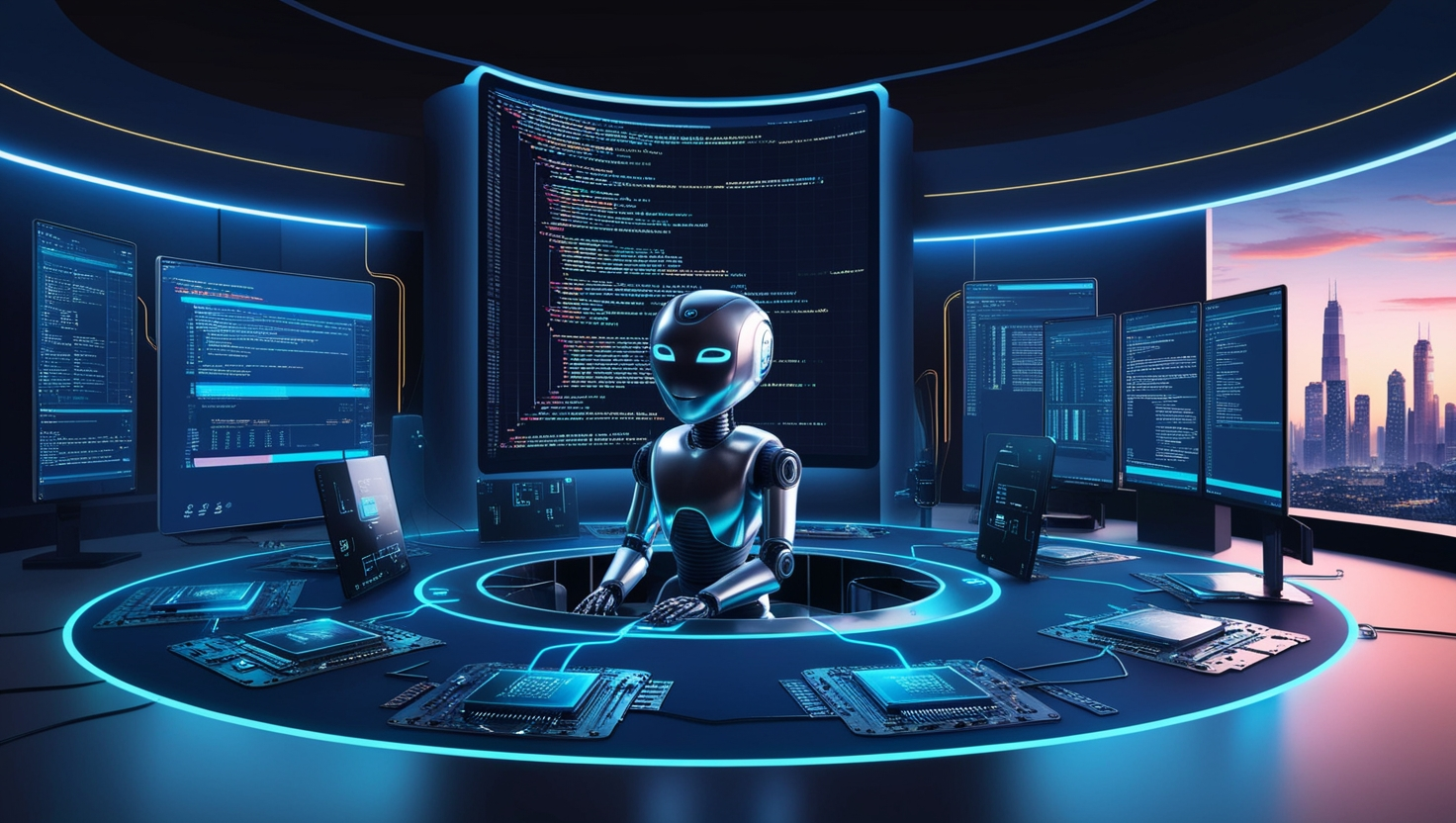
Software development is entering a new phase as artificial intelligence moves beyond simple code completion and begins taking on more complex, multi-step tasks. AI agents can analyze requirements, write code, test applications, identify bugs, work with development tools, and even suggest improvements with limited human intervention.
This shift is changing how developers approach their daily work. Instead of spending most of their time manually writing repetitive code, developers can increasingly focus on architecture, problem-solving, product decisions, and reviewing AI-generated work. For readers interested in emerging technology and digital innovation, TheTechyX.Com offers a useful destination for exploring technology-related topics and trends.
What Are AI Agents in Software Development?
AI agents are software systems designed to perform tasks by interpreting information, making decisions, and taking actions toward a specific objective. Unlike traditional AI assistants that mainly respond to individual prompts, agents can often manage a sequence of related actions.
In software development, an AI agent might receive a task such as fixing a bug in an application. It could inspect the relevant files, understand the existing code, identify a potential cause, make a change, run tests, examine the results, and revise its approach if the first solution fails.
This ability to work through multiple steps makes AI agents particularly valuable for development teams. They are not simply replacing the keyboard work of programmers; they are becoming active participants in the software engineering workflow.
AI Agents Are Automating Repetitive Coding Tasks
One of the most immediate effects of AI agents is the automation of repetitive development work.
Developers frequently spend time creating boilerplate code, writing basic functions, generating tests, updating documentation, converting code between formats, and handling routine configuration tasks. While these activities are important, they do not always require extensive creative problem-solving.
AI agents can accelerate many of these processes. A developer can describe the desired functionality in natural language and allow an agent to generate an initial implementation. The developer can then review, modify, and approve the result.
This approach can significantly reduce the time required to move from an idea to a working prototype. It also allows experienced developers to spend more time on higher-value engineering decisions.
Faster Debugging and Problem Solving
Debugging is another area where AI agents can make a substantial difference.
Traditional debugging often involves reading error messages, searching through files, reproducing problems, testing possible solutions, and repeating the process until the underlying issue is discovered. AI agents can help coordinate several of these activities.
For example, an agent can examine an error report, trace the relevant code path, identify suspicious logic, and propose a correction. It may also generate a test designed to reproduce the problem and verify whether the proposed fix resolves it.
The developer still plays an important role because AI-generated solutions can contain mistakes. However, having an intelligent system perform the initial investigation can shorten the debugging cycle and reduce the amount of manual work involved.
AI Agents Are Changing Software Testing
Testing is essential for reliable software, but writing and maintaining tests can consume significant development time.
AI agents can generate unit tests based on existing functions, identify potential edge cases, and create additional scenarios that developers may not initially consider. They can also help analyze failed tests and connect failures with potentially problematic areas of the codebase.
Automated testing becomes even more powerful when an AI agent can operate continuously throughout development. Instead of waiting until the end of a project to discover problems, development teams can use agents to check changes as they are introduced.
This supports a more iterative development process in which coding, testing, debugging, and refinement happen together.
From Code Generation to Software Engineering
The most important change may be the transition from AI-generated code to AI-assisted software engineering.
Early coding assistants primarily helped developers complete lines or blocks of code. Modern AI agents can work with larger objectives and interact with multiple development tools.
A developer might provide a high-level requirement such as creating a customer authentication feature. The agent could help break the requirement into smaller tasks, generate implementation code, create tests, inspect dependencies, and document the resulting functionality.
This does not mean developers become unnecessary. Instead, their responsibilities can move toward supervising AI systems, defining requirements, validating architectural decisions, and ensuring that the final product meets business and technical requirements.
Developers Are Becoming AI Supervisors and Reviewers
As AI takes over more implementation tasks, human developers may increasingly act as reviewers and decision-makers.
The ability to evaluate AI-generated code becomes just as important as the ability to produce code manually. Developers need to understand whether a solution is secure, efficient, maintainable, scalable, and appropriate for the application.
This creates a new engineering skill set. Professionals may need stronger abilities in prompt design, system architecture, code review, testing strategy, security analysis, and AI governance.
Rather than eliminating programming knowledge, AI agents may make strong technical knowledge even more valuable because humans remain responsible for determining whether an AI-generated solution is actually correct.
Improved Developer Productivity
The biggest practical benefit of AI agents is productivity.
When developers can delegate repetitive activities to intelligent systems, projects may progress more quickly. Small teams can potentially accomplish tasks that previously required considerably more manual effort.
AI agents can also reduce context switching. A developer does not necessarily need to stop working on a complex feature to manually create documentation, write repetitive tests, or investigate a straightforward error. An agent can assist with these supporting activities.
However, productivity should not be measured simply by how much code an AI system generates. High-quality software depends on correctness, security, usability, and maintainability. Generating thousands of lines of code quickly is not useful if those lines introduce serious technical problems.
New Challenges and Risks
Despite their advantages, AI agents introduce important challenges.
One major concern is accuracy. AI systems can generate code that appears convincing while containing subtle errors. Developers therefore need effective review and testing processes.
Security is another major consideration. An AI-generated implementation may accidentally introduce vulnerabilities, misuse dependencies, expose sensitive information, or follow an unsafe pattern. Organizations need appropriate safeguards before allowing agents to make changes to production systems.
There are also questions surrounding privacy, intellectual property, accountability, and access control. When an AI agent can interact with repositories, databases, development environments, and deployment systems, organizations must carefully determine what the agent is permitted to access and modify.
The NIST AI Risk Management Framework provides a useful reference for organizations thinking about managing AI-related risks responsibly.
The Future of Agentic Software Development
AI agents are likely to become increasingly integrated into development environments. Future systems may coordinate multiple specialized agents, with one handling implementation, another reviewing security, another creating tests, and another analyzing performance.
Development workflows could become more conversational. Instead of navigating numerous tools manually, developers may describe a desired outcome and allow AI systems to coordinate much of the underlying process.
This could also change the structure of software teams. Developers may spend less time on routine implementation and more time on architecture, product strategy, system design, and quality assurance.
At the same time, organizations will need clear policies governing when AI agents can act independently and when human approval is required.
Conclusion
AI agents are changing software development by moving artificial intelligence from a passive coding assistant toward an active participant in the engineering process. They can help developers write code, debug problems, create tests, analyze projects, and automate repetitive workflows.
The technology does not simply represent an opportunity to produce code faster. Its larger impact is the potential to change how software is designed, built, tested, and maintained.
Developers who learn to collaborate effectively with AI agents can potentially become more productive while focusing on the decisions that require human judgment. The future of software development is therefore unlikely to be purely human or purely automated. Instead, it will increasingly involve humans directing intelligent systems while remaining responsible for the quality, security, and purpose of the software they create.
