
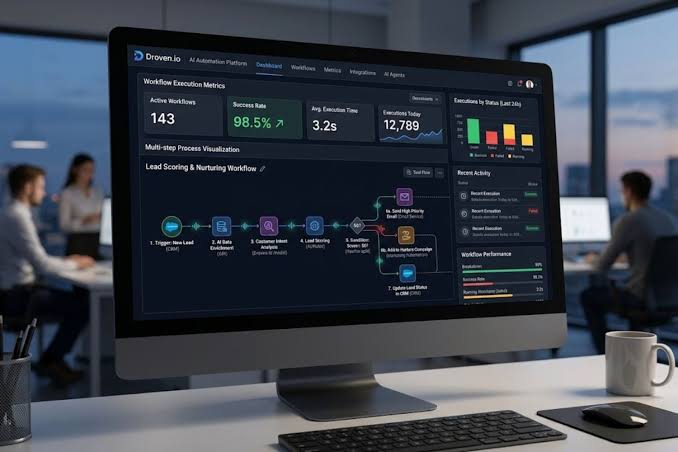
Modern businesses depend on dozens of daily processes, from managing customer inquiries and organizing internal tasks to processing data and coordinating teams. When these activities are handled manually, even simple operations can consume valuable time and create opportunities for mistakes. Workflow automation provides a practical way to make these processes faster, more consistent, and easier to manage.
A workflow automation platform helps businesses connect repetitive tasks into structured processes that can run with minimal manual intervention. Instead of employees repeatedly moving information between applications, sending routine notifications, or checking whether a task has been completed, automation can handle these steps according to predefined rules.
For organizations exploring modern automation solutions, aboutdrovenio.com/ provides information about Droven.io and its approach to simplifying business operations through automation, data management, performance tracking, and collaboration. The broader goal of workflow automation is not simply to remove human involvement, but to help teams spend more time on work that requires judgment, creativity, and strategic thinking.
What Is Workflow Automation?
Workflow automation is the process of using software to execute repetitive or rule-based activities automatically. A workflow may begin with a trigger, such as receiving a form submission, creating a new customer record, completing a task, or reaching a specific deadline.
Once the trigger occurs, the system can perform a sequence of predefined actions. These might include assigning a task, updating information, sending a notification, requesting approval, or moving a process to its next stage.
For example, imagine a company receiving a new customer inquiry. In a manual process, an employee might read the inquiry, enter the customer information into another system, notify a salesperson, and create a follow-up reminder. An automated workflow can connect these steps so that the process happens consistently with little manual effort.
This makes automation especially useful for businesses that handle high volumes of repetitive activities.
Why Businesses Are Turning to Automation
The growing interest in workflow automation is closely connected to the increasing complexity of modern business operations. Companies often use multiple applications for communication, customer management, finance, project management, analytics, and document storage.
Without an organized workflow, employees may spend significant amounts of time switching between these systems.
Automation can address several common operational problems:
Reducing Repetitive Work
Employees should not have to spend hours performing the same simple actions every day. Automating repetitive processes can free time for more valuable responsibilities.
Improving Consistency
Manual processes can vary depending on who performs a task. Automated workflows follow predefined instructions, helping businesses maintain greater consistency.
Reducing Human Error
Copying information, updating records, and transferring data manually can lead to mistakes. Automation can reduce unnecessary manual data entry and improve process reliability.
Increasing Operational Visibility
A well-designed workflow can make it easier to understand where a process currently stands. Managers can identify completed tasks, pending actions, and potential bottlenecks more efficiently.
According to IBM, workflow automation can help reduce repetitive work, improve process speed, minimize errors, and support better scalability.
Key Features to Look for in a Workflow Automation Platform
Not every automation platform provides the same capabilities. Businesses should evaluate platforms according to the complexity of their processes and the needs of their teams.
Workflow Creation
A useful platform should make it possible to design workflows that reflect real business processes. Users should be able to define triggers, actions, conditions, and task sequences without unnecessarily complicated configuration.
Data Management
Automation often depends on accurate and accessible data. A strong platform should help organizations organize information and ensure that the right data reaches the right step of a workflow.
Performance Tracking
Businesses need to know whether automation is actually improving operations. Monitoring tools and performance information can help identify delays, recurring problems, and areas for improvement.
Team Collaboration
Automation should not isolate employees from important processes. Instead, it should make collaboration easier by assigning responsibilities, sharing information, and notifying the appropriate people when action is required.
Scalability
A workflow that works for a small team may not be sufficient when the business grows. Automation solutions should be capable of handling increasing workloads and more complex processes without requiring organizations to rebuild everything from scratch.
Common Workflow Automation Use Cases
Workflow automation can be applied across many departments and industries.
Marketing
Marketing teams can automate activities such as lead assignment, campaign notifications, customer follow-ups, and reporting processes. This allows marketers to spend more time developing campaigns and analyzing results.
Sales
Sales teams can automate lead routing, follow-up reminders, customer updates, and internal notifications. When a prospect completes a specific action, the appropriate salesperson can be alerted automatically.
Human Resources
HR departments can automate employee onboarding, document collection, approval processes, training reminders, and internal notifications. This creates a more organized experience for both employees and HR teams.
Finance
Financial workflows can include invoice processing, approval requests, payment notifications, and record updates. Automation can help reduce delays while maintaining consistent procedures.
Customer Support
Support teams can use workflows to route incoming requests, assign tickets, send status notifications, and escalate unresolved issues. This can help ensure that important customer requests do not remain unnoticed.
Workflow Automation vs. Manual Processes
The biggest difference between automated and manual workflows is how repetitive decisions and actions are handled.
In a manual process, employees are responsible for remembering each step and completing it individually. This can work for simple operations with low volumes, but problems often appear as workload increases.
An automated process uses defined rules to move work forward. For example:
- A customer submits information.
- The system records the information.
- The relevant team receives a notification.
- A task is assigned automatically.
- A follow-up reminder is created.
- The workflow moves to the next stage after completion.
This structure reduces the number of routine actions employees need to perform themselves.
However, automation should not be viewed as a replacement for every human decision. Complex situations may still require employees to review information, make judgments, or handle exceptions.
How to Implement Automation Successfully
Choosing an automation platform is only the beginning. Businesses also need a thoughtful implementation strategy.
Start With Repetitive Processes
The best starting point is usually a process that happens frequently and follows predictable steps. Automating a complicated process before understanding it can create unnecessary problems.
Map the Existing Workflow
Before automating, document how the process currently works. Identify triggers, tasks, approvals, responsible employees, delays, and common errors.
Remove Unnecessary Steps
Automation should not simply make an inefficient process happen faster. Review the workflow first and remove steps that do not add meaningful value.
Set Clear Rules
Define what should happen under different conditions. Clear rules make workflows easier to maintain and reduce unexpected outcomes.
Monitor Results
After deployment, measure whether the workflow is achieving its purpose. Useful indicators may include processing time, error rates, task completion rates, and employee workload.
Improve Continuously
Business requirements change over time. A workflow should be reviewed periodically to ensure that it still matches the organization’s needs.
The Role of Data in Workflow Automation
Data is one of the most important elements of modern automation. Workflows often depend on information from customers, employees, applications, forms, databases, or business systems.
Poor-quality data can undermine an otherwise well-designed automated process. For this reason, organizations should establish clear rules for collecting, updating, validating, and storing information.
Good data practices can also improve reporting. Once workflow activity is recorded consistently, businesses can analyze where processes slow down and which activities require improvement.
This creates an important feedback loop: automation performs the process, data shows what happened, and that information helps teams improve the workflow.
Automation and the Future of Business Operations
Workflow automation is becoming increasingly connected with artificial intelligence, analytics, and intelligent decision-making. Traditional automation generally follows predefined rules, while newer systems can incorporate AI to analyze information and assist with more complex activities.
This does not mean every workflow needs artificial intelligence. Rule-based automation remains highly useful for predictable processes. The right approach depends on the task, the available data, and the level of decision-making involved.
IBM describes workflow orchestration as coordinating multiple automated tasks across applications and services so they work together as part of an end-to-end process. This distinction is important as businesses move from automating isolated tasks toward connecting complete operational processes.
Platforms focused on simplicity, scalability, data visibility, and collaboration can therefore become valuable parts of a broader digital transformation strategy.
Final Thoughts
Workflow automation can transform the way businesses handle repetitive work. By connecting tasks, organizing data, improving visibility, and reducing unnecessary manual activity, automation allows teams to operate more efficiently while concentrating on higher-value responsibilities.
The most successful automation strategies begin with practical problems rather than technology for its own sake. Businesses should identify repetitive processes, understand how those processes work, select suitable automation capabilities, and continuously measure the results.
As organizations continue adopting digital tools, workflow automation platforms such as Droven.io represent the broader movement toward simpler, more connected, and data-driven business operations. When implemented thoughtfully, automation can help organizations save time, improve consistency, support collaboration, and create a stronger foundation for sustainable growth.
Frequently Asked Questions
What is a workflow automation platform?
A workflow automation platform is software that helps businesses create and manage automated sequences of tasks. It can trigger actions based on events, conditions, or predefined rules.
What types of businesses can use workflow automation?
Almost any organization with repetitive processes can benefit from workflow automation. Common applications include sales, marketing, finance, human resources, customer support, and operations.
Does workflow automation eliminate human workers?
No. Automation is primarily useful for repetitive and predictable tasks. Employees can remain responsible for decisions, creative work, customer relationships, and situations that require human judgment.
What should businesses automate first?
Businesses should generally begin with repetitive, high-volume processes that follow clear rules. Examples include notifications, data transfers, task assignments, reminders, and approval processes.
How can businesses measure automation success?
Organizations can compare processing times, error rates, employee workload, completion rates, and operational costs before and after automation. These measurements help determine whether the workflow is delivering meaningful improvements.

Leave a Reply